Dawn of War IV is a base-building real-time strategy game, not a hero brawler. If you last played Dawn of War III, the rhythm will feel different: build a base, take the map, keep squads alive and push with a real army. This briefing covers the systems that matter before you touch a campaign.
What kind of RTS is Dawn of War IV?
KING Art describes the game as a return to classic Dawn of War gameplay “refined for modern strategy fans.” In practice, the confirmed feature set points to the original game’s shape: large bases, capture points, infantry squads, vehicles and walkers, cover, garrisoning and big armies. The official site lists base building, map control, cover, Sync Kills and a Unit Veterancy System as core features.
That does not mean it is a copy of 2004. Preview coverage describes modern quality-of-life features, including group target assignment and abilities that can be set to fire automatically. Those are preview observations, not a full control-scheme specification. What matters for a new player is simpler: this is a game about economy, map presence and preserving units, not about controlling one hero.
The campaign has four factions and more than 70 missions, plus a two-mission Astra Militarum prologue. Skirmish, competitive multiplayer and Last Stand sit alongside it. You can read the campaign structure guide for the full picture.
Start with the prologue, then the intended order
The campaign opens with a two-mission prologue in command of the Astra Militarum alongside the Blood Ravens. It is the tutorial and the story setup. After that, the game recommends a faction order: Orks, Adeptus Mechanicus, Necrons, then Space Marines. Preview coverage reports that the game allows other orders but advises this sequence to avoid spoiling the connected narrative.
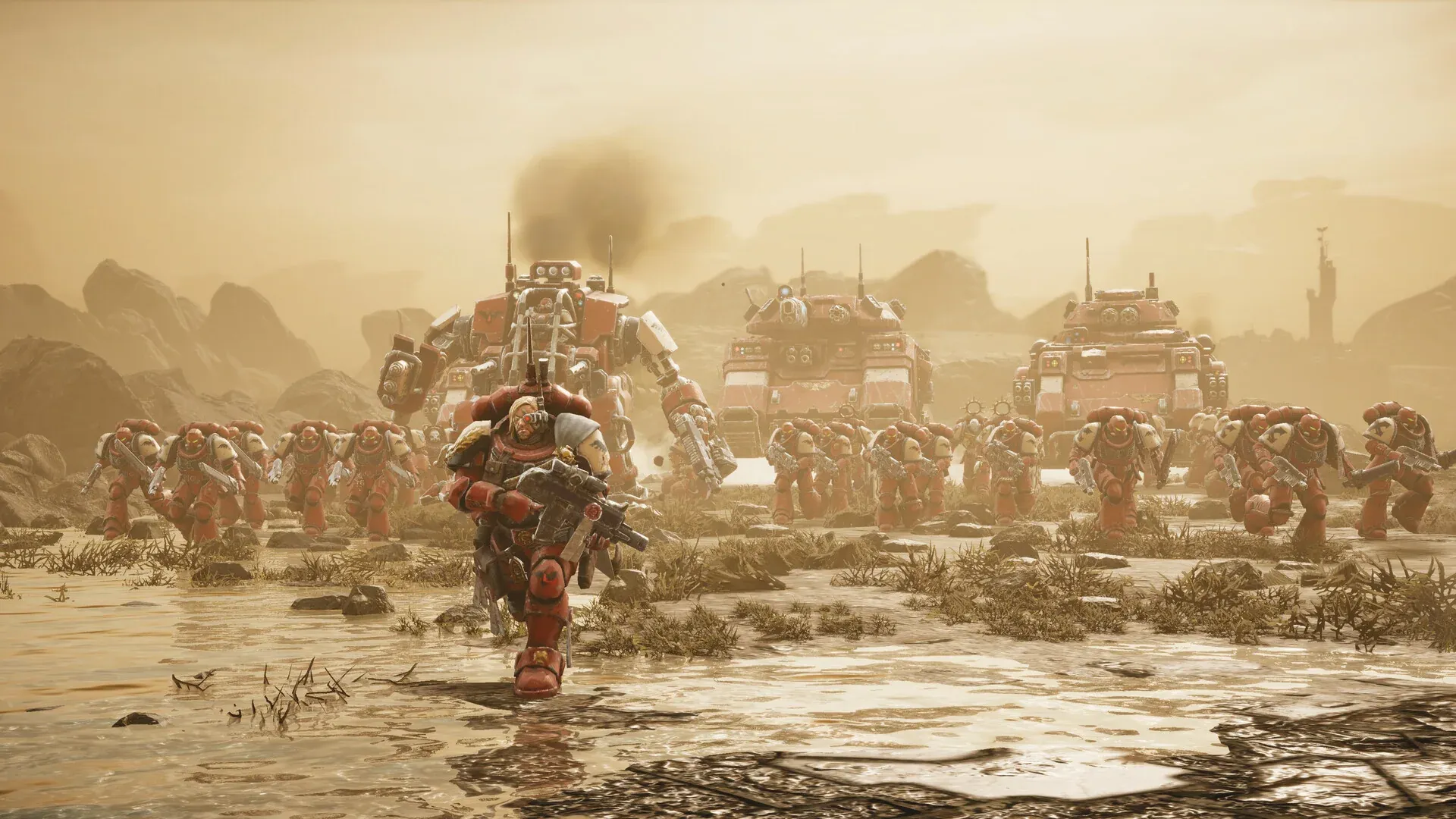
The Ork campaign is the most forgiving place to learn. Orks are cheap, aggressive and quick to replace, which makes mistakes less punishing. The Adeptus Mechanicus and Necrons demand more deliberate base management. The Space Marines close the story with elite, expensive units and two playable Chapters.
- Prologue: learn the interface, capture flow and basic commands.
- Orks: learn aggression, map spread and the value of cheap units.
- Adeptus Mechanicus: learn network planning and ranged firepower.
- Necrons: learn patience, attrition and fighting inside your own bonuses.
- Space Marines: learn elite unit preservation and multi-front response.
The core loop: build, take, reinforce, push
Every match follows a version of the same loop. Build the infrastructure that produces units. Send those units to capture and hold resource points. Convert the income into more units, upgrades or technology. Then use the army to deny the opponent’s income or destroy their base. The faction differences change how each step feels, not the existence of the loop.
- Establish production. Build the minimum infrastructure needed to field a working army. Do not queue buildings you cannot defend.
- Take nearby resource points. Early map presence matters more than a perfect build. Capture, then upgrade when the front is stable.
- Scout. Find out what the opponent is building. A raid you can see coming is much less dangerous.
- Trade with intent. Losing a squad is acceptable if it buys a capture, a tech structure or a better fight elsewhere.
- Convert an advantage. A won fight should become a captured point, a destroyed production building or a dead expansion — not an idle army.
Previewers repeatedly noted that amassing a large army and rolling over the map can work in base-building missions. That does not make it efficient. On higher difficulties and in multiplayer, the player who controls more income and loses fewer squads will usually get to the big army first.
Requisition and Power are not the same problem
Dawn of War IV uses resource points and a Power economy. The official Space Marines advice is explicit: deny them Resource Points, especially Power, because their units are expensive and Power-hungry. That tells you something important about the game’s economy: requisition gets bodies onto the field, but Power gates the expensive and advanced options.
The practical rule is to look at your faction’s expensive units before the match and ask what is actually blocking them. If you are floating requisition but cannot afford vehicles or upgrades, you do not need another infantry squad; you need Power and the map control that protects it. If you are floating Power but cannot replace losses, the opposite is true.
Cover is a position, not a paint job
Cover returns as either directional cover or garrisonable structures, not as terrain-wide cover values painted across every piece of ground. Orks can build their own cover, the Adeptus Mechanicus can build garrisonable structures, and the Necrons do not use cover at all. Flamers and grenades can negate cover; melee combat forces units out of it.
Treat cover as a tool for holding a point or surviving a ranged exchange, not as a force field. If your opponent refuses to leave cover, do not feed infantry into the front; break the position with the right weapon, a grenade, or a melee push from another angle.
Keep squads alive; veterancy is an investment
Units grow stronger as they survive. The Unit Veterancy System is one of the official headline features, and it changes the economics of a fight: a veteran squad that retreats and reinforces is often more valuable than a fresh squad that trades one-for-one. Retreat sends a unit to the closest production structure with reduced damage taken, but you lose control of it for a time; the retreat icon turns yellow, allowing the order to be cancelled.
On-field reinforcement is the other half of that equation. It commits resources to keep a unit fighting, and the developers describe it as the most powerful of the three preservation tools. It is also a trap: auto-reinforcing many units drains resources quickly. You can win the fight and lose the war. Necrons have a unique variant of the mechanic.
- Retreat early. A squad at half strength that escapes is still a squad. A wiped squad is gone.
- Do not trickle. Reinforcements that arrive one at a time feed the enemy’s veterancy instead of yours.
- Protect your damage dealers. Snipers, anti-armour squads and support weapons are force multipliers; losing them costs more than losing a line squad.
- Use garrisons for fragile units. A garrisoned squad can keep firing while the enemy has to commit to dislodge it.
Stratagems are a second resource
Command points and Stratagems add a layer of active abilities on top of unit control. Preview coverage describes earning command points by fighting and holding capture points, then spending them on faction-specific abilities. Examples include orbital bombardment for the Space Marines and a whole-army Waaagh! buff for the Orks.
For Orks, Stratagems are free according to the official faction advice. That is a real economic advantage: an Ork player should be looking for reasons to spend command points, not hoarding them for a perfect moment. For everyone else, the question is whether the Stratagem creates a capture, saves a squad or wins a fight you were going to lose anyway.
Which faction should you start with?
The safest answer for a returning RTS player is Orks. They are the most forgiving, the cheapest to field and the easiest to understand: take space, make more units, keep attacking. Polygon’s preview also positioned the Orks as the recommended starting faction.
Choose the Space Marines if you prefer elite units and accept that every loss hurts. Choose the Necrons if you like attrition and slow, deliberate pushes. Choose the Adeptus Mechanicus if you enjoy planning a network and unlocking a powerful late game. The faction comparison goes deeper, and each faction has a full dossier in the faction files.
Common mistakes to avoid
- Expanding before securing. A resource point you cannot defend is a donation with extra steps.
- Ignoring Power. Expensive units and research stall without it, and stalling is how a winning position becomes a losing one.
- Fighting into the Necron Power Matrix. Their bonuses are strongest inside it. Attack elsewhere or drag them out.
- Trying to outproduce the Adeptus Mechanicus. Their advice is explicit: you cannot. Break the network instead.
- Chasing Orks across the map. Chip their bases, punish overextensions and do not let the Waaagh! roll uncontested.
- Playing the Space Marines like a horde. Elite armies lose wars of attrition. Force multiple fights, then win the ones that matter.
- Forgetting the campaign map. Missions are chosen from a world map; defending one location can mean losing another. Read the consequences before you commit.
Before launch: a short readiness check
The confirmed PC requirements are unusually heavy on storage: 125 GB. The minimum is a Windows 11 machine with 16 GB of RAM and a GTX 1660 or RX 5700; recommended is 32 GB and an RTX 3060 Ti or RX 9060 8GB. Check the full specifications before buying, especially if you are still on Windows 10, which is not listed.
Decide on an edition before 30 November if you want the three-day early unlock. The edition comparison explains what the Commander Edition actually contains. If you are undecided about a faction, use the faction finder rather than guessing from colour schemes.