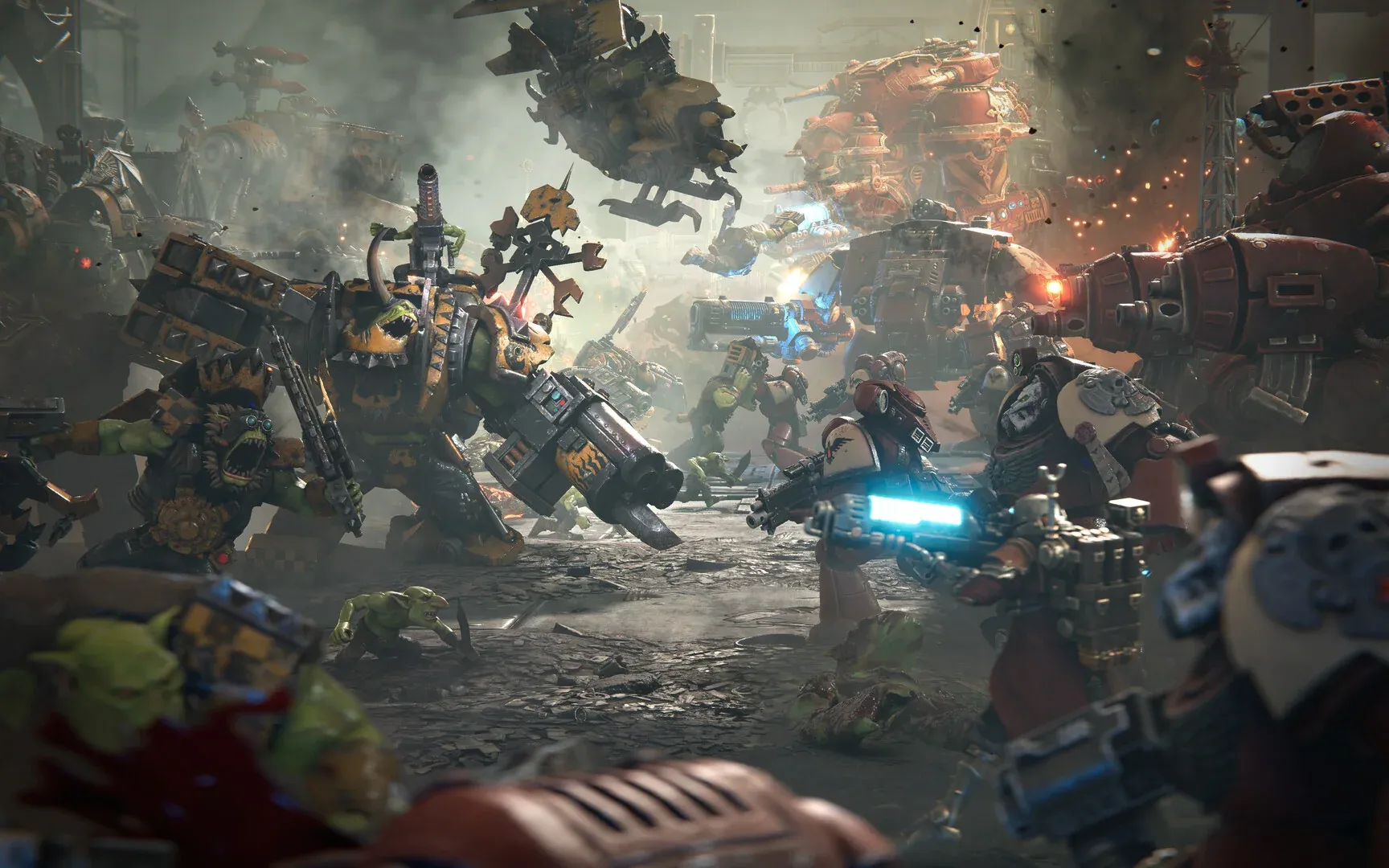
Dawn of War IV’s competitive layer is deliberately familiar: 1v1, 2v2 and 3v3 across 30 maps, with all four launch factions and a Commander chosen before the match. The details that decide how it actually plays — matchmaking, map pool, balance — are still under wraps.
Confirmed formats
The official overview confirms three team sizes: 1v1, 2v2 and 3v3. The game is online through Steam on Windows. Deep Silver has not announced crossplay, split-screen or a console version. If you are coming from a console RTS, plan for mouse and keyboard on PC.
Thirty multiplayer maps are confirmed for launch. Each of the four free Year One updates ships with a map pack, but the publisher has not said how many maps each pack contains or which modes they support. The launch map pool’s names and layouts have not been published.
Annihilation, Domination and Maelstrom
The three Quick Match rulesets were spelled out in KING Art’s October 2026 multiplayer AMA. Annihilation is the default, but players can select any one, or all three, for matchmaking.
| Mode | Win condition | What it rewards |
|---|---|---|
| Annihilation | Destroy all enemy headquarters and protect your own. | Base pressure, defence and finishing power. |
| Domination | Capture and hold more Strategic Positions than your opponents to gain Victory Points. | Persistent map control and defended positions. |
| Maelstrom | Secure objectives that dynamically appear across the map to gain Victory Points. | Mobility, scouting and fast redeployment. |
The AMA does not publish Victory Point thresholds, the rate at which points accrue, or objective timing. Those are match settings and balance values that can change; do not treat a number from a preview video as a launch rule. The official 2v2 press material also names a Team Domination variant, but its exact team-specific scoring has not been detailed.
Cover, retreat and on-field reinforcement
The official AMA describes three preservation tools that matter more than any pre-launch tier list:
- Cover: directional cover or garrisonable structures. Orks can build their own cover; the Adeptus Mechanicus can build garrisonable structures; Necrons do not use cover at all. Flamers, grenades and melee can negate or force units out of cover.
- Retreat: disengages a unit and sends it to the closest production structure with reduced damage taken, at the cost of losing control for a period. The retreat icon turns yellow after a time, allowing the order to be cancelled.
- On-field reinforcement: commits resources to keep a unit fighting. It is described as the most powerful of the three tools, but auto-reinforcing many units drains resources quickly. Necrons have a unique variant.
This is why a “winning” fight can still lose a match. If you auto-reinforce through every engagement, you may hold the field and still fall behind on tech or production. The economy is part of combat.
Commanders in PvP: chosen before, built during
Multiplayer Commanders are generic faction units named by rank, such as the Captain or Skorpekh Lord. One is selected before the match alongside faction and starting position, then produced from the headquarters for a cost, usually after some unlocks. Match settings can make the Commander a starting unit or disable Commanders entirely.
This is a meaningful design choice. A Commander is not a free hero that enters with the opening units by default. It is a mid-match investment, which means the opening minutes are about army composition and map control, not racing to a hero. The option to start with a Commander or turn them off lets custom games change that relationship.
The 11 campaign commanders and their generic multiplayer counterparts are catalogued in the commander index.
Maps: thirty at launch, more in Year One
Thirty maps is a large launch pool for an RTS. It is also a warning against early tier lists: a map pool that size will produce very different matchup spreads, and the community will need time to learn them. The full list is not public, so any “best map for faction X” claim before launch is guesswork.
The Year One plan adds Map Packs I–IV alongside the free updates. The roadmap places them with Crusade Mode, Lord Ahmnok, the Mission Editor and Guzcutta. Exact contents and dates are not announced. See the roadmap guide.
Faction matchups: use the developer’s own advice
The official faction pages are unusually direct about how each army should be played and attacked. Those are the best public starting points for matchup thinking, even though they are not a balance chart.
- Space Marines: win individual fights early, preserve veteran squads, force the opponent to fight on multiple fronts. Beat them by trading efficiently and denying Power.
- Orks: spread bases, keep pressure on and spend free Stratagems. Beat them by chipping buildings and punishing reckless advances.
- Necrons: fight inside the Power Matrix and outlast. Beat them by attacking outside the matrix, striking elsewhere and finishing units outright.
- Adeptus Mechanicus: build the Noosphere Network early and protect the relays. Beat them by destroying Cogitator Relays and closing the distance to their firing line.
The faction files contain the full how-to-play and how-to-counter lists with sources.
Co-op and Skirmish are separate from PvP
The campaign supports two-player online co-op. Last Stand is three-player co-op. Skirmish supports play against AI, with up to five AI opponents and dozens of customisable settings. None of these are a substitute for competitive matchmaking, but they are useful for learning maps and build timings without ladder pressure.
The October preview build included 1v1 Skirmish against the AI and five smaller 1v1 maps. That is a limited slice; it does not confirm the full launch map set or the quality of the AI at release.
What is not confirmed
- Matchmaking rules, ranking systems and seasonal structure.
- Server regions, dedicated server availability and latency handling.
- Anti-cheat, reporting tools and moderation policy.
- The full 30-map list, map sizes and mode support per map.
- Victory Point thresholds, gain rates and objective timing for Domination and Maelstrom.
- Crossplay, controller support and Steam Deck verification.
- Whether replays, observers or custom lobbies are included.
How to prepare without a launch build
- Pick one faction and learn its economy. The official playstyle advice is enough to build a mental model; the faction comparison helps you choose.
- Practise the core loop in Skirmish. Capture, upgrade, scout, reinforce and convert a won fight. Do not worry about exact build orders yet.
- Learn the counter-advice for every faction. Knowing how your army wants to be attacked is as important as knowing how it attacks.
- Play the campaign. The missions teach faction mechanics in a controlled environment, and co-op lets you learn with a partner.
- Wait for the launch build before chasing meta. Balance changes between preview and release; a tier list published in November is not a launch guide.